

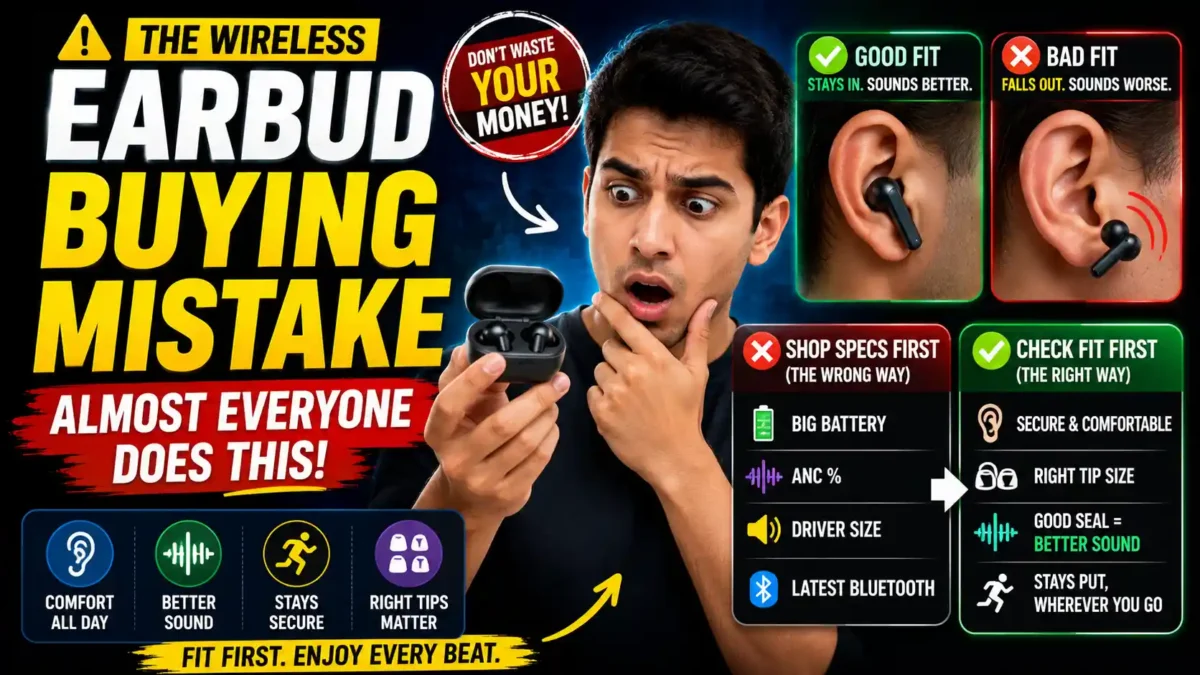
Most earbud buyers focus on the wrong thing before checkout. Here’s the mistake that quietly ruins the experience, and what to check instead.
You compare a few spec sheets, pick the pair with the biggest battery number or the brand name you already trust, and check out feeling pretty good about it. Two weeks later, the earbuds are sitting in a drawer because they hurt, fall out during a walk, or just sound thin. The wireless earbuds buying mistake almost everyone makes has nothing to do with picking the “wrong brand.” It’s shopping the spec sheet before shopping the fit.
Fit decides whether earbuds get used every day or abandoned within a month, and it has almost nothing to do with price. This article breaks down why that mistake is so easy to make, what actually determines whether a pair works for you, and what to check before you spend money on your next set.
The mistake: shopping specs before shopping fit
Most people shop for wireless earbuds the way they’d shop for a laptop: compare numbers, pick the best combination for the price, done. Driver size, battery life, active noise cancellation percentage, codec support. These numbers are easy to compare side by side, which is exactly why they end up driving the decision. The problem is that none of them matter if the earbuds don’t physically seal in your ear canal.
Fit should be the first filter when shopping for earbuds, because a poor seal weakens bass response and passive noise isolation no matter how good the drivers are. That single fact undoes most spec-sheet comparisons before they even start. A pair with mediocre drivers and a great seal will often sound better in your actual ears than a pair with excellent drivers and a loose, ill-fitting tip.
What makes this mistake so easy to fall into is that it’s invisible until you’re already home. A product page can show you a frequency response chart. It can’t show you the shape of your ear canal, and most people have never really thought about that shape before, because wired earbuds and over-ear headphones were far more forgiving of a mediocre fit.
Why fit gets skipped in the first place
Part of this comes down to how earbuds are marketed. Battery life and noise cancellation percentages are dramatic, easy to put in bold text on a box, and simple to compare across brands. Fit is personal, unglamorous, and impossible to communicate in a listing. No retailer puts “may not fit your specific ear canal” on the packaging, even though that single variable affects satisfaction more than almost anything else on the spec sheet.
READ MORE
There’s also a habit carried over from headphone shopping generally. With over-ear headphones, fit issues are rare and mostly about clamping pressure. With in-ear buds, fit is the entire game. Ears aren’t a standard size, and even the two ears on your own head are frequently slightly different from each other, which is why some people end up needing a different tip size in each ear.
One thing that stood out while researching this topic is how consistently comfort gets flagged as the most overlooked factor across buying guides aimed at completely different audiences, budget shoppers and premium buyers alike. It’s rarely framed as the headline advice, even though nearly every source treats it as the real dividing line between earbuds people love and earbuds people quietly stop wearing.
How do you know if wireless earbuds actually fit?
A properly fitted earbud creates a snug seal without pressure or pain, stays in place during movement, and produces full, present bass rather than thin or tinny sound. The right ear tip should create a secure seal in the ear canal without feeling painful, and the sound should come through full and rich once that seal is right. If the audio sounds hollow or the bass disappears, that’s usually a fit problem, not a sound quality problem, and swapping tip sizes solves it more often than people expect.
Most earbuds ship with three or four tip sizes precisely because manufacturers know one size won’t work for everyone. Very few buyers actually try all of them. The habit of leaving the default medium tips in place and never testing the others is one of the quieter reasons earbuds get returned or abandoned. It costs nothing and takes about two minutes to test every size that came in the box, in each ear separately, before deciding a pair “just isn’t for you.”
The second layer of the mistake: buying for the wrong use case
Even once fit is handled, there’s a related mistake sitting right behind it: buying earbuds tuned for a use case that isn’t actually yours. Someone who mostly wants a pair for gym sessions and commuting doesn’t need the same earbuds as someone doing quiet, critical music listening at a desk, and someone who lives on video calls has a completely different priority list from either of them.
READ MORE
Active noise cancellation is the clearest example of this mismatch. Top-tier noise cancellation in current earbuds blocks upward of 90 percent of external noise in lab testing, while budget ANC in the lower price tiers still works more like a basic mute filter, fine for casual use but not enough for flights or loud open offices. If you commute on a loud train or fly often, that difference matters enormously. If you mostly use earbuds at home, it barely matters at all, and paying a premium for flagship ANC in that case is money spent solving a problem you don’t have.
Battery life claims deserve the same scrutiny. The number brands love to advertise is total battery life including the charging case, but what actually affects daily use is how long the earbuds last on a single charge before you need to reach for the case again, and anything under six hours of continuous listening with ANC on becomes a real inconvenience. A pair advertising 30 hours “total” might only offer five or six hours per charge, which is a very different experience from a pair that genuinely lasts eight hours before its first recharge.
What actually determines sound quality once fit is right?
Once the seal is solid, sound quality comes down to how the earbuds are tuned, not just their raw specs. Codec support gets more attention from buyers than it usually deserves, since common codecs are perfectly adequate for most listeners, and connection reliability, avoiding dropouts and lag, tends to affect daily satisfaction more than a marginal jump in bitrate. A pair that connects reliably and holds a stable signal during video playback will feel better day to day than a pair with a marginally better codec that occasionally stutters.
What separates genuinely good earbuds from average ones at similar prices is usually the tuning decisions a company made rather than any single number on the spec sheet, whether it leans toward boosted bass, a flatter, more neutral profile, or something tuned specifically for spoken word and podcasts. None of that shows up cleanly in a comparison table, which is part of why the mistake of shopping specs first is so easy to make.
A quick way to shop that avoids the mistake
Start with your actual use case before opening a single product page. Are these mainly for workouts, commuting, calls, or quiet listening? That answer narrows the field more than any spec comparison will, since it tells you whether ANC strength, microphone quality, or sound signature should be the deciding factor.
From there, check the return policy before you check the reviews. Because fit is impossible to judge from a listing, a flexible return window matters more for earbuds than for almost any other electronics purchase. If a retailer offers a short or no-return window on earbuds, that’s worth factoring into the decision itself, regardless of how good the specs look.
Once the earbuds arrive, test every included tip size in both ears before forming an opinion on sound quality. Wear them for a full commute or workout, not just a five-minute test at your desk, since fit problems and pressure discomfort often only show up after 20 or 30 minutes of continuous wear.
A mediocre driver with a perfect seal will usually beat a great driver with a loose one. Fit isn’t a nice-to-have on the spec sheet. It’s the filter everything else has to pass through first.
What this looks like for different phones and use cases
Phone ecosystem plays a smaller role than people assume, but it’s not nothing. iPhone users are generally steered toward earbuds optimized for Apple’s ecosystem, Galaxy owners toward Samsung’s own lineup, and anyone using Android more broadly or switching between multiple devices toward brands like Sony or Bose that prioritize cross-platform compatibility and multipoint connections. None of that overrides the fit issue. It just narrows which brand’s tip shapes and sizing you’re likely to be trying first.
READ MORE
After comparing buying guides aimed at gym-goers, commuters, and audiophiles side by side, the difference in what actually mattered was smaller than the marketing suggests. Nearly every guide, regardless of who it was written for, circled back to the same two things: does it seal properly, and does it match what you’ll actually use it for. Everything past that point is refinement, not the core decision.
Frequently asked questions
Why do my earbuds keep falling out even though they’re expensive?
Price has very little to do with fit. Expensive earbuds still ship with a small set of standard tip sizes, and if none of them match your ear canal shape, they’ll fall out regardless of how much the pair cost. Try every included tip size before assuming the earbuds themselves are the problem.
Do I need high-end active noise cancellation?
Only if you’re regularly in loud environments like flights, trains, or open offices. For home use or quiet commutes, mid-range or even basic ANC is usually enough, and paying extra for flagship-level cancellation may not be noticeable in daily life.
Does a higher-bitrate codec always mean better sound?
Not automatically. A higher-bitrate codec helps most when the earbud tuning is already good and the fit is already solid. On a mismatched or poorly sealed earbud, a better codec won’t fix the underlying problem, since the bottleneck is the seal and tuning, not the data being transmitted.
How long should wireless earbuds actually last on a charge?
Look at per-charge battery life, not the combined total with the case. Aiming for at least six to eight hours of continuous listening with noise cancellation turned on is a reasonable baseline for daily use without constant recharging.
Is it worth buying earbuds without trying them on first?
It’s common and usually fine, as long as you buy from a retailer with a real return policy and commit to testing every tip size and wearing them for an extended period before judging comfort or sound. Treat the first few days as a fit trial, not a final verdict.
Conclusion
The wireless earbuds buying mistake almost everyone makes is comparing numbers before comparing fit, and then compounding it by choosing a pair tuned for someone else’s use case instead of their own. Specs are easy to shop and fit is not, which is exactly why so many good-looking purchases end up back in a drawer within a month. Start with how you’ll actually use them, insist on a real return window, and test every tip size before deciding a pair isn’t worth keeping. Get that order right, and most of the disappointment people associate with wireless earbuds simply doesn’t happen.

You Might Also Like
Best Wireless Microphone for Mobile: A Buyer’s Guide
16mm Movie Projector: Why Collectors Love It, But You Probably Want a Digital Projector

Best Gadgets for Dropshipping: Top Tech Products to Sell in 2026

The Ultimate GE Profile UltraFast Combo 2-in-1 Review: Does AI Work?

How to Earn Money From an AI Agent in 2026

Leave a Reply