
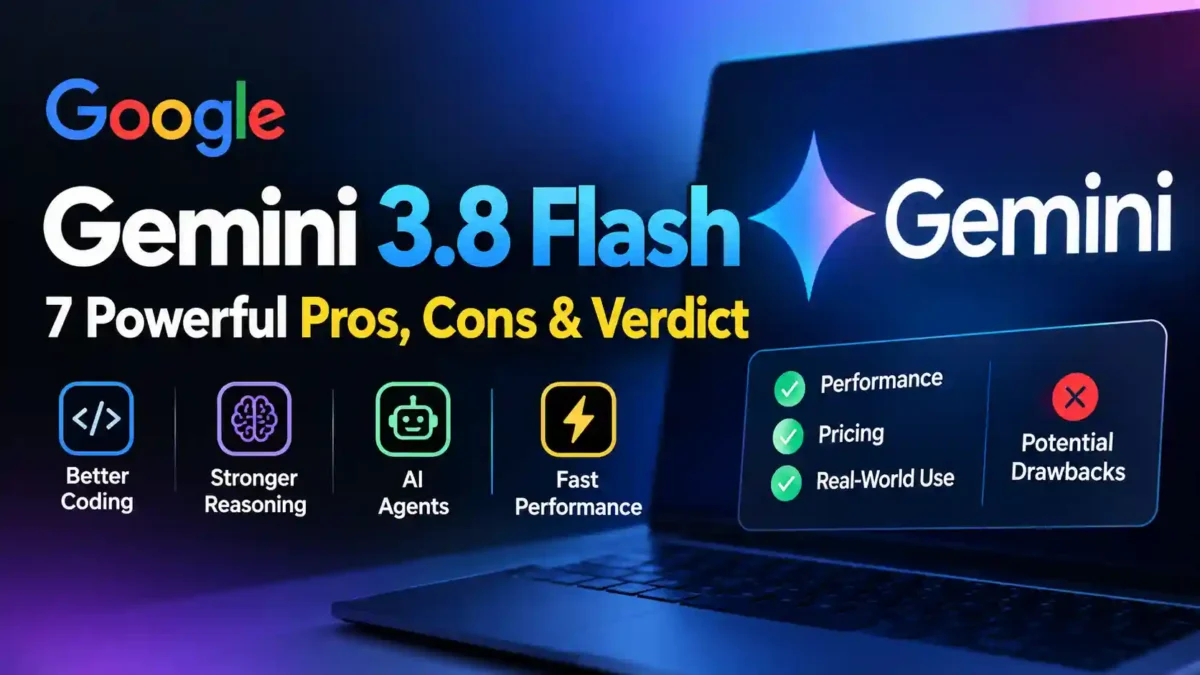

Gemini 3.8 Flash is Google’s latest Flash model, released on September 2, 2026, with a stronger focus on reasoning, software engineering, AI agents, and complex multi-step work. Google says it can take additional reasoning steps and make repeated tool calls when a task requires more work.
The interesting part is the tradeoff: the launch price matches Gemini 3.7 Flash, but heavier reasoning can increase how many tokens a task consumes.
For everyday users, that distinction may not matter much. For developers building coding agents or other automated workflows, it matters a lot. This review looks at the actual numbers, the pricing change scheduled for 2027, the strengths and weaknesses reported by users, and whether Gemini 3.8 Flash makes sense compared with Gemini 3.7 Flash and competing models.
What Is Gemini 3.8 Flash?
Gemini 3.8 Flash is Google’s latest Flash-series model for fast AI workloads that also require stronger reasoning. Google describes it as its most intelligent workhorse model and says it improves on Gemini 3.7 Flash across software engineering, agentic tasks, and specialized multi-step reasoning.
Google released Gemini 3.8 Flash only three weeks after Gemini 3.7 Flash. The company also says Gemini 3.8 represents its third Flash release in six weeks, showing how quickly the Flash line is changing.
The model is available to developers through Google’s AI development platforms, to enterprise customers through Gemini Enterprise, and to Google AI Pro and Ultra subscribers through supported consumer products. Google’s official announcement provides the current availability details and launch pricing.
If you are already exploring AI tools for content creation, coding, or automation, you may also find our guide to AI agent workflows and automation useful for understanding where models like this fit into real projects.
How Much Does Gemini 3.8 Flash Cost?
The introductory API price for Gemini 3.8 Flash is $0.75 per 1 million input tokens and $3.75 per 1 million output tokens. Those rates are the same introductory prices Google announced for Gemini 3.7 Flash.
READ MORE
There is an important catch. Google’s launch documentation says the introductory price expires on December 31, 2026. Beginning January 1, 2027, the listed regular rates become $1.50 per 1 million input tokens and $7.50 per 1 million output tokens.
That means the current price should not be treated as the permanent cost of Gemini 3.8 Flash. Developers planning a production application for 2027 should calculate their expected expenses using the regular rates rather than assuming the introductory pricing will continue.
Google’s official launch announcement confirms both the introductory rates and the scheduled January 2027 pricing change. Read Google’s official Gemini 3.8 Flash announcement for the current pricing and availability information.
Why Can Gemini 3.8 Flash Cost More Per Task?
The confusing part of Gemini 3.8 Flash pricing is that the per-token price does not tell the entire story.
Google designed the model to spend more effort on difficult problems. That can mean more reasoning tokens, more generated output, and additional tool calls. So two models with identical token prices can still have very different costs for completing the same job.
The Verge reported early analysis suggesting that task-level costs could increase by about 40 percent because Gemini 3.8 Flash can produce more output and use more agentic evaluation steps. That figure is an early analysis rather than a universal cost increase for every workload.
In practical terms, a short question may not create a meaningful difference. A complicated coding task that requires several rounds of analysis and tool use can be much more expensive.
That is why developers should track cost per completed task, rather than looking only at the published price per million tokens.
Gemini 3.8 Flash Performance: What Do the Benchmarks Show?
Google’s published benchmark results show that Gemini 3.8 Flash improves on Gemini 3.7 Flash in several areas, especially tasks involving software engineering and agentic workflows.
READ MORE
| Benchmark | Gemini 3.8 Flash | Gemini 3.7 Flash |
|---|---|---|
| DeepSWE v1.1 | 73.7% | 65.3% |
| Vals Finance Agent v2 | 61.4% | 59.0% |
| Harvey’s Legal Agent Benchmark | 10.0% | 8.8% |
| Terminal-bench 2.1 | 89.4% | 85.8% |
Google’s model card reports a 73.7% score on DeepSWE v1.1, compared with 65.3% for Gemini 3.7 Flash. The same model card reports 61.4% on Vals Finance Agent v2, compared with 59.0% for the previous model.
The Terminal-bench 2.1 result is also notable. Google’s model information lists Gemini 3.8 Flash at 89.4%, compared with 85.8% for Gemini 3.7 Flash.
These numbers suggest that the upgrade is most meaningful when the task involves coding, tools, or multiple steps. They do not mean that Gemini 3.8 Flash wins every benchmark or every type of AI workload.
Google’s published model card also shows that performance varies by benchmark. For example, its standard comparison table lists 45.4% for Gemini 3.8 Flash and 45.7% for Gemini 3.7 Flash on one HLE evaluation. That is a useful reminder not to turn a handful of strong benchmark results into a claim that the model is universally better.
Is Gemini 3.8 Flash Better for Coding?
Yes, the available benchmark data suggests that Gemini 3.8 Flash is particularly strong for coding and agentic software tasks. The largest improvement over Gemini 3.7 Flash in Google’s model-card comparison appears on DeepSWE v1.1, a benchmark focused on long-horizon software engineering.
This matters because coding agents increasingly have to do more than generate a function. They may need to inspect files, understand a codebase, modify several components, run commands, examine failures, and continue working until the task is complete.
Gemini 3.8 Flash is designed for this type of workflow. Its ability to make repeated tool calls gives it more room to inspect results and adjust its approach.
Google Cloud’s developer documentation also reports higher scores for Gemini 3.8 Flash than 3.7 Flash on Terminal-bench 2.1, SWE-Bench Pro, SWE-Atlas, and banking-related agent evaluations.
For developers, this is probably the strongest reason to consider the upgrade. If your workload is mostly simple text generation, the difference may be much less important.
How Does Gemini 3.8 Flash Compare With Gemini 3.7 Flash?
| Category | Gemini 3.8 Flash | Gemini 3.7 Flash |
|---|---|---|
| Introductory input price | $0.75 per 1M tokens | $0.75 per 1M tokens |
| Introductory output price | $3.75 per 1M tokens | $3.75 per 1M tokens |
| Long-horizon coding | Stronger | Lower |
| Agentic workflows | Stronger | Less capable |
| Token efficiency | Potentially lower on difficult tasks | Generally easier to control |
| Best fit | Complex tasks and agents | Efficiency-focused workloads |
The choice is therefore not simply about replacing the older model. Gemini 3.7 Flash can still make sense when a task is straightforward and token efficiency matters.
READ MORE
Gemini 3.8 Flash makes more sense when the additional reasoning can help finish a difficult job that would otherwise require more human intervention.
What Are the Real Problems With Gemini 3.8 Flash?
This is where the model looks less impressive than a simple benchmark comparison suggests.
Recent Reddit discussions from Gemini and Google Antigravity users contain complaints about excessive token usage, verbosity, long reasoning loops, and cases where the model repeatedly inspected the same files. One user reported that a coding task consumed a very large portion of their usage quota before producing an unsatisfactory result.
These reports are individual experiences, not controlled benchmark results. They should not be treated as proof that Gemini 3.8 Flash behaves this way for everyone. But they reveal a real friction point that is easy to miss when reading Google’s benchmark tables.
Another Reddit discussion reported that using the highest thinking setting could substantially increase token consumption without producing an obvious improvement for some medium-difficulty tasks. The practical lesson is simple: maximum reasoning effort is not necessarily the right setting for every request.
In my view, this is the most important weakness to watch. A model that is willing to work harder can be excellent when the task is genuinely difficult. But if it spends large amounts of computation on routine work, the extra intelligence can become wasted budget.
Gemini 3.8 Flash Pros and Cons
Pros:
READ MORE
- Strong improvement over Gemini 3.7 Flash on several coding and agent benchmarks.
- Useful for long-running software engineering tasks.
- Supports more complex multi-step reasoning and repeated tool use.
- Introductory API pricing is relatively low compared with several larger frontier models.
- Available across Google’s developer, enterprise, and consumer AI products.
Cons:
- Higher reasoning effort can consume substantially more tokens.
- Real-world task cost can therefore be higher than the headline token price suggests.
- Some users report excessive verbosity and repeated reasoning loops.
- The introductory pricing ends after December 31, 2026.
- Strong benchmark results do not mean it is the best model for every workload.
How Does Gemini 3.8 Flash Compare With Other AI Models?
Google’s own model-card comparison places Gemini 3.8 Flash alongside models such as Claude Opus 5, Claude Sonnet 5, and GPT-5.6 variants. On DeepSWE v1.1, Google reports 73.7% for Gemini 3.8 Flash, compared with 74.0% for Claude Opus 5 and 72.7% for GPT-5.6 Sol.
That comparison is interesting because Gemini 3.8 Flash is positioned at a much lower listed token price than those larger models. Google’s model card lists $0.75 introductory input pricing and $3.75 output pricing for Gemini 3.8 Flash, while the same table lists substantially higher rates for the competing models.
However, benchmark proximity should not be confused with universal superiority. Different models can behave differently depending on the prompt, tool setup, context, reasoning configuration, and application.
If you’re choosing a model for an actual product, testing your own workload is more useful than selecting a winner from one benchmark table.
Who Should Use Gemini 3.8 Flash?
Gemini 3.8 Flash is most compelling for developers who need an AI model to complete complicated work rather than simply answer short prompts.
READ MORE
It is particularly worth evaluating for coding agents, automated research systems, multi-step business workflows, financial analysis agents, legal workflow experiments, and applications that repeatedly call external tools.
For basic chat, simple extraction, routine rewriting, or lightweight classification, the additional reasoning may not justify the extra token consumption.
This is similar to choosing any other software tool. More capability is useful only when your workload actually needs it.
Is Gemini 3.8 Flash Worth Using in 2026?
Gemini 3.8 Flash is worth testing in 2026 if your work involves coding, complex reasoning, or AI agents. The published benchmark improvements are meaningful, and the introductory API pricing is attractive for developers who can control token usage.
But I would not automatically migrate every workload from Gemini 3.7 Flash. The reports about token consumption and occasional reasoning loops make a controlled comparison more sensible.
For a production application, run the same representative tasks through both models. Record successful completions, retries, latency, output tokens, and total cost. That will tell you much more than a generic benchmark ranking.
If you’re interested in building AI-powered content workflows, you can also compare this approach with the AI tools covered in our free AI video generator guide, especially if your goal is to combine text reasoning with media creation.
Frequently Asked Questions About Gemini 3.8 Flash
What is Gemini 3.8 Flash?
Gemini 3.8 Flash is Google’s latest Flash-series AI model, designed for faster AI workloads that also require stronger reasoning, coding, and agentic capabilities.
READ MORE
How much does Gemini 3.8 Flash cost?
The introductory API price is $0.75 per 1 million input tokens and $3.75 per 1 million output tokens. Google says those introductory rates expire on December 31, 2026.
What will Gemini 3.8 Flash cost in 2027?
Google’s official announcement lists regular pricing beginning January 1, 2027, at $1.50 per 1 million input tokens and $7.50 per 1 million output tokens.
Is Gemini 3.8 Flash better than Gemini 3.7 Flash?
Gemini 3.8 Flash performs better than Gemini 3.7 Flash on several published coding and agent benchmarks, including DeepSWE v1.1 and Terminal-bench 2.1. However, the improvement varies by workload.
Does Gemini 3.8 Flash use more tokens?
It can. The model is designed to spend more reasoning effort on difficult tasks, which can result in more output and higher task-level token consumption.
Is Gemini 3.8 Flash good for coding?
Yes. Coding and long-horizon software engineering are among the areas where Gemini 3.8 Flash shows some of its clearest improvements over Gemini 3.7 Flash.
Final Verdict
Gemini 3.8 Flash is an interesting upgrade because Google is changing what a Flash model is expected to do. Instead of focusing primarily on quick responses, the model is designed to spend more effort on difficult problems, use tools repeatedly, and work through longer software and agentic tasks.
The benchmark data supports that direction. Gemini 3.8 Flash improves over 3.7 Flash on several important coding and agent evaluations, including DeepSWE v1.1, where Google’s model card reports 73.7% versus 65.3% for the previous model.
The main catch is efficiency. More reasoning can mean more tokens, and early user reports suggest that the model can sometimes be overly verbose or spend too much time on a task. The scheduled pricing increase in January 2027 also needs to be included in any serious long-term cost calculation.
So, is Gemini 3.8 Flash worth it? For complex coding and agent workloads, I think it is one of the more interesting models to test. For simple everyday tasks, Gemini 3.7 Flash or another efficient model may still be the better choice.
The smartest approach is not to ask which AI model is universally best. Test the models against the work you actually need them to perform, then choose the one that delivers the best balance of quality, speed, reliability, and total task cost.
Sources for the factual data in this article include Google’s official Gemini 3.8 Flash announcement and the Google DeepMind Gemini 3.8 Flash model card. User-reported limitations referenced above come from recent Reddit discussions and are presented as individual reports rather than verified product-wide behavior.

You Might Also Like

Best AI Tools for Beginners: 7 Easy Picks for 2026

The Only Free AI Tool Everyone Should Use, and it is Open Source: An Overview

How to Build a Chrome Extension With AI in 7 Easy Steps

AI Existential Risk: Anthropic’s 10% Warning Explained

Automatic Caption Generator: 5 Costly Mistakes to Avoid
Leave a Reply