
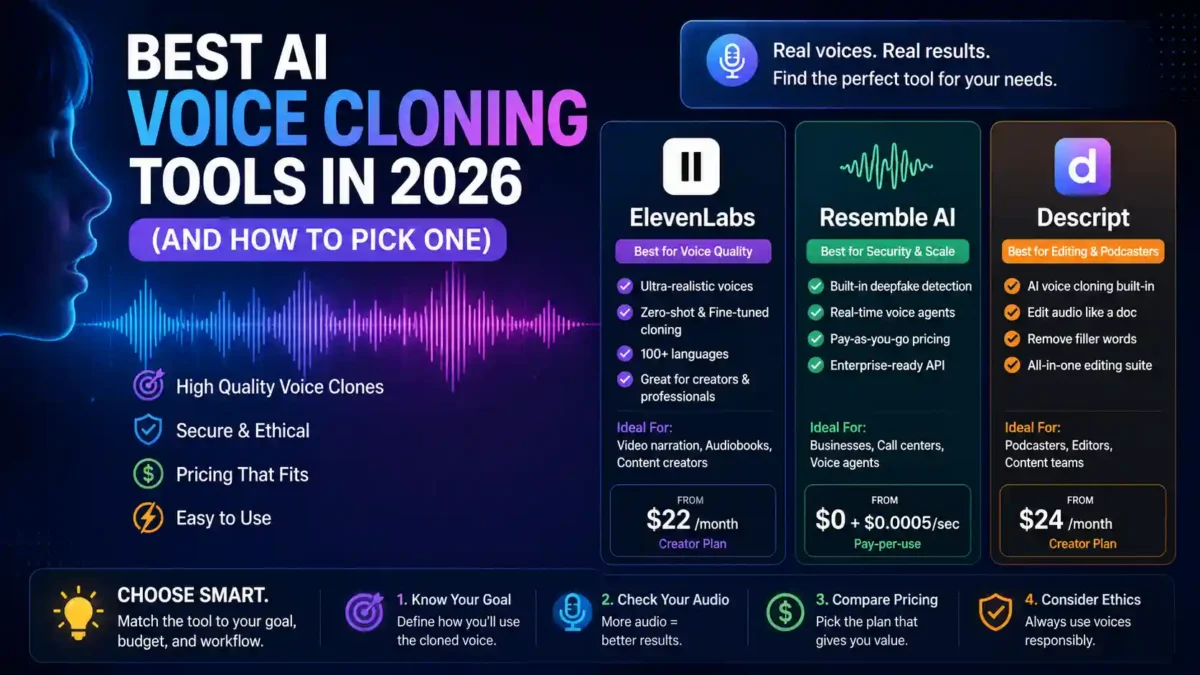

If you’re trying to find the best AI voice cloning tools in 2026, here’s the short version: ElevenLabs still wins on raw voice quality, Resemble AI is the pick if you also need deepfake protection built in, and Descript is the one to grab if you’re already editing podcasts or video. But which one actually fits your project depends on a handful of things most “top 10” lists skip past, so let’s walk through them one at a time.
A cloned voice used to take minutes of clean audio and a fair bit of patience. That’s changed fast. According to TextToLab’s 2026 voice cloning guide, some free open-source models can now produce a convincing clone from just 5 seconds of audio on a regular consumer GPU, a huge drop from the 5-plus minutes and $99-a-month subscriptions that were standard just two years earlier. That shift is exactly why picking the right tool matters more than it used to. Quality is no longer the bottleneck. Fit is.
What Is AI Voice Cloning, and How Does It Work?
AI voice cloning is the process of using machine learning to create a synthetic copy of a human voice. You provide a sample of someone speaking, and the system learns the unique characteristics of that voice: pitch, tone, pacing, accent, and the subtle ways they pronounce certain sounds. Once trained, the model can generate new speech in that voice from any text you provide.
There are two main approaches. Zero-shot cloning requires only a few seconds of audio and produces a usable clone almost instantly. Fine-tuned cloning requires 30 minutes to several hours of recordings but delivers a more accurate and expressive result, especially for long-form narration or emotional range. The method you choose depends on how much sample audio you have and how critical perfect fidelity is for your project.
Understanding this distinction matters because it directly affects which tool you should pick. If you only have a 20-second voice memo, you’re choosing a zero-shot tool whether you like it or not. If you have hours of studio-quality recordings, a fine-tuned clone will reward that investment.
Step 1: Nail Down What You’re Actually Cloning a Voice For
This sounds obvious, but it’s the step that saves you the most money. A YouTuber who wants a consistent narrator voice for faceless videos has completely different needs than a game studio building NPC dialogue, or a company setting up a phone support agent. Before you compare a single tool, be honest with yourself about which of these you’re doing:
READ MORE
- Narrating videos or audiobooks in your own cloned voice
- Building a real-time voice agent for customer calls or apps
- Editing podcast audio where you occasionally need to fix a flubbed word
- Dubbing content into other languages while keeping the original speaker’s voice
Each of those points toward a different platform, and knowing which one you are keeps you from paying for enterprise features (or a real-time API) you’ll never touch. For example, a podcaster who just needs to fix a mispronounced word will find Descript’s integrated editing workflow far more useful than a standalone cloning tool. A developer building a phone bot needs low-latency streaming, which is a different technical requirement entirely.
Step 2: Check How Much Sample Audio You Actually Have
Voice cloning tools split roughly into two camps. Zero-shot tools like ElevenLabs Instant, Fish Audio, and the open-source Chatterbox model need only 5 to 30 seconds of clean audio and generate a usable clone almost instantly. Fine-tuned cloning, the kind ElevenLabs Professional and Resemble AI offer, wants 30 minutes to several hours of recordings, but the payoff is a clone that holds up better across long-form narration and emotional range, per TextToLab’s breakdown of cloning methods.
If all you have is a 20-second voice memo from your phone, you’re choosing a zero-shot tool whether you like it or not. If you have access to a quiet room and a decent microphone, spending 30 minutes recording a script can dramatically improve the final result. The quality of your sample audio matters more than the tool you choose.
Is ElevenLabs Still the Best AI Voice Cloning Tool in 2026?
For pure voice fidelity in English, yes, most reviewers still rank it first. Fish Audio’s own comparison guide puts it plainly: for English-only projects with a flexible budget, ElevenLabs delivers the highest fidelity of any platform tested, while Fish Audio’s 2026 platform breakdown notes it remains the benchmark other tools get measured against. That said, “best” doesn’t mean “cheapest” or “easiest,” and the pricing structure trips a lot of first-time users up.
READ MORE
Step 3: Actually Look at the Pricing Before You Commit
ElevenLabs runs on a credit system, and it’s more layered than the homepage lets on. As of August 2026, the lineup runs Free ($0, about 10,000 credits or roughly 10 minutes of speech), Starter ($6/month), Creator ($22/month with 100,000 credits, or about 100 minutes of narration, plus professional voice cloning access), Pro ($99/month), Scale ($299/month), and Business ($990/month), according to pricing figures verified against ElevenLabs’ own page and reported by Flexprice’s August 2026 pricing guide. Annual billing knocks that down by roughly 17%, or about two months free. Most solo creators land on Creator, since that’s the first tier that unlocks proper voice cloning rather than just preset voices.
Descript prices differently since it bundles cloning into a full editing suite. Its Creator plan runs $24 a month and includes 30 hours of media plus full access to its AI Speech cloning feature, per Autoppt’s 2026 roundup of voice cloning tools, which also notes Descript requires you to read a consent statement aloud before it will build a clone, a small but genuinely useful safeguard against misuse.
Resemble AI takes a third approach entirely: pay-per-use. Its Flex plan starts at $0 and bills around $0.0005 per second of generated audio, on top of a flat $2 a month for a “rapid” voice clone (built from a 10-second sample) or $5 a month for a “professional” clone trained on 10 to 25-plus minutes of audio, according to a May 2026 Resemble AI pricing breakdown. That works out to roughly $1.80 for an hour of finished audio before add-on fees, which can undercut a flat ElevenLabs tier if your volume is modest, though it can also creep up fast if you’re running something like a busy phone system.
How Do ElevenLabs and Resemble AI Actually Compare?
Since these two get compared constantly and solve slightly different problems, here’s how they stack up on the things that actually matter when you’re picking one.
READ MORE
| Factor | ElevenLabs | Resemble AI |
|---|---|---|
| Entry-level paid plan | Creator, $22/month, 100,000 credits | Flex, $0 base, pay per second used |
| Voice cloning method | Zero-shot and Professional (fine-tuned) | Rapid ($2/mo) and Professional ($5/mo) clones |
| Standout feature | Highest-rated raw voice fidelity in English | Built-in deepfake detection (Detect) and watermarking (Verify) |
| Best fit | Solo creators, narrators, dubbing | Enterprises needing compliance and provenance tracking |
| Notable limitation | Some users report occasional mispronunciations and limited pacing controls | Not built for real-time conversational agents on its own |
| Free tier | Yes, 10,000 credits (~10 min) | Yes, pay-per-use with no monthly minimum |
| Multilingual support | Strong in English, expanding in others | Good, with enterprise focus |
Step 4: Weigh the Real Complaints, Not Just the Star Ratings
Most review sites hand ElevenLabs a near-perfect score, and on balance that’s earned. But dig into actual user reviews and a couple of consistent gripes show up. A Capterra reviewer who used the platform for six to twelve months in financial services praised the voice quality but flagged that it sometimes mispronounces words and offers limited control over tone, speed, and pauses within a sentence. That’s a real friction point, not a nitpick. If your script has technical jargon, names, or numbers that need to land exactly right, plan on a manual proofreading pass no matter which tool you use.
There’s also a bigger, less comfortable issue worth knowing about. A study from the Center for Countering Digital Hate tested six voice cloning services, including ElevenLabs, Descript, and PlayHT, by asking each to clone the voices of eight major political figures. Out of 240 total requests, 193 were fulfilled, generating audio of public figures saying things they never actually said, and ElevenLabs was the only one of the six that blocked any of the attempts outright, refusing 25 of 40 cases, as reported by TechCrunch’s coverage of the study. It’s a good reminder that voice cloning guardrails vary a lot between platforms, and it’s worth checking a tool’s consent policy before you build anything that touches a real person’s likeness.
I’ll be honest, the first time I read through that CCDH study I expected the numbers to be closer. Seeing that four out of five services would happily generate a fake statement from a sitting official, with almost no pushback, changed how I think about which platform gets my card number. It’s not that ElevenLabs is flawless here (it still let through a chunk of requests involving EU political figures it apparently hadn’t flagged yet), but “some friction” beats “none” when the stakes are this high.
Step 5: Consider Whether You Need Multilingual or Real-Time Cloning
If your project spans more than one language, ElevenLabs isn’t automatically your best option. Fish Audio’s S2 Pro model does zero-shot voice cloning across more than 80 languages from a single audio sample, according to TextToLab’s comparison of cloning approaches, which makes it a genuinely strong pick for dubbing or international content where ElevenLabs’ English-first tuning shows its limits.
READ MORE
For latency-sensitive, real-time use, like a live voice agent answering phone calls, Resemble AI’s Chatterbox Turbo model runs around 75 milliseconds of latency, fast enough that a caller generally won’t notice a delay. If you’re building an interactive voice response system or a real-time translation tool, that low latency is a hard requirement, not a nice-to-have.
Step 6: Factor In the Legal and Ethical Side Before You Launch
This part isn’t optional anymore. Starting August 1, 2026, the EU AI Act’s Article 50 requires synthetic audio to carry provenance marking, with fines that can reach €35 million for noncompliance, per the same Resemble AI pricing analysis. If any part of your audience or business touches the EU, that’s a real compliance question, not a hypothetical one. Resemble AI’s Verify watermarking exists largely to address exactly this, which is part of why it leans so heavily into enterprise and government clients.
Also worth checking regardless of jurisdiction: who owns the rights to a cloned voice once you upload the sample. Some platforms, including Resemble, state that you retain full ownership. Others use license terms that grant the company broader rights to your voice data for research purposes, so it’s genuinely worth reading the terms before you upload anything. If you’re cloning your own voice, you should understand exactly what you’re agreeing to.
Step 7: Test Before You Commit to a Paid Plan
Every major platform here offers some kind of free tier or trial, so use it. Run the same script through two or three tools with your actual sample audio, not a demo voice, and listen for the things a spec sheet won’t tell you: how it handles your accent, whether it stumbles on your specific vocabulary, and whether the pacing feels natural when you read it back at normal speed. Your own ears really are the best judge here, more than any comparison chart, including this one.
READ MORE
A practical test: take a 30-second script that includes a product name, a number, and a technical term. Run it through each tool. Count how many corrections you need to make. The tool that requires the fewest edits is the one that fits your workflow best, even if its marketing page claims lower accuracy than a competitor.
Common Mistakes When Choosing a Voice Cloning Tool
- Choosing based on price alone. Fix: factor in editing time, consent safeguards, and output quality. A cheaper tool that requires more corrections can cost more in the long run.
- Not checking the consent policy. Fix: read the terms before uploading a voice sample. Understand who owns the rights and how the data is used.
- Ignoring latency for real-time projects. Fix: if you’re building a conversational agent, test the tool’s streaming latency, not just its offline quality.
- Assuming one tool fits all languages. Fix: test multilingual output separately. English-first tools may struggle with other languages.
- Skipping the free trial. Fix: always test with your own audio before paying. Demo voices don’t reflect your specific use case.
- Forgetting about watermarking and compliance. Fix: if you operate in regulated markets, check whether the tool provides provenance marking.
Frequently Asked Questions
What is the best AI voice cloning tool for beginners in 2026?
ElevenLabs’ free plan is the easiest starting point since it needs no fine-tuning and produces a usable voice within seconds, though you’ll need to upgrade to the Creator plan for full voice cloning rights.
How much audio do I need to clone a voice?
Zero-shot tools like ElevenLabs Instant or Fish Audio need as little as 5 to 30 seconds of clean audio, while fine-tuned professional clones typically want 30 minutes or more for the best results.
Is AI voice cloning legal?
Cloning your own voice, or a voice you have explicit permission to use, is legal in most places, but cloning someone else’s voice without consent can violate publicity rights, and new rules like the EU AI Act’s Article 50 now require disclosure that audio is synthetic.
Can I tell if audio is an AI voice clone?
Listen for an unusually flat tone, odd pauses, or uniform pitch across a recording, and for more certainty, tools like Reality Defender or a check for C2PA Content Credentials can help verify authenticity.
Which tool is cheapest for occasional use?
Resemble AI’s pay-per-use Flex plan is generally cheapest for light, occasional use since you’re only billed for the seconds of audio you generate, roughly $1.80 per finished hour, rather than paying for an unused monthly quota.
Can I use voice cloning for commercial projects?
Yes, but you need to check the license terms of the tool you choose. Most paid plans include commercial rights, but free tiers often restrict commercial use. Always verify before publishing.
What is the difference between zero-shot and fine-tuned cloning?
Zero-shot cloning uses a short sample to generate a voice instantly. Fine-tuned cloning trains a model on a larger dataset, resulting in better accuracy and emotional range, but it requires more audio and setup time.
Does voice cloning work for singing?
Some tools can clone singing voices, but results vary. Singing requires more precise pitch and timing control, so it’s best to test with your specific use case before committing to a tool.
So, back to the original question: what are the best AI voice cloning tools in 2026? ElevenLabs for the best all-around voice quality, Resemble AI if compliance and deepfake protection matter to you, Fish Audio if you’re working across languages, and Descript if cloning is just one piece of a bigger editing workflow. Pick based on your actual use case and sample audio, run a real test with your own script, and check the consent policy before you commit. That’s genuinely more useful than chasing whichever tool tops this month’s ranking.

Leave a Reply