
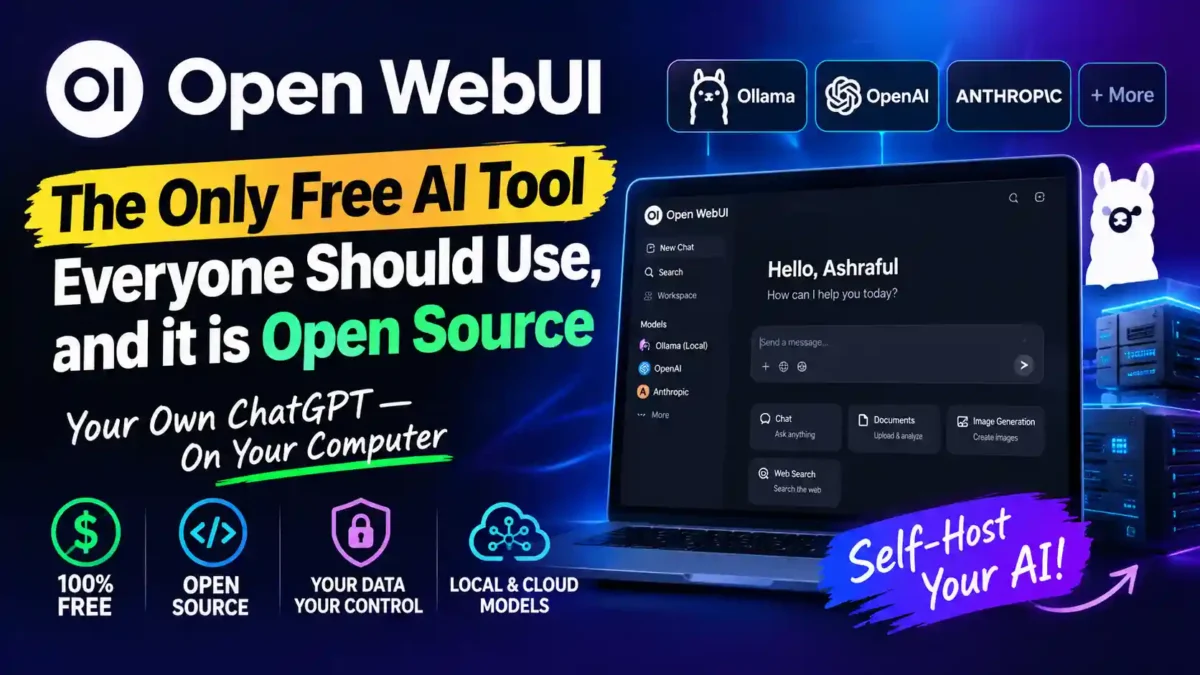

The only free AI tool everyone should use, and it is open source, is Open WebUI, a self-hosted chat interface that turns any computer with enough RAM into your own private ChatGPT.
If you’ve been paying for a monthly AI subscription while your prompts and replies sit on someone else’s servers, this is the tool that changes that math. It connects to local models through Ollama or to cloud APIs like OpenAI and Anthropic, and it puts you in control of where your data actually lives.
Open WebUI, the self-hosted AI platform built by developer Timothy Jaeryang Baek, started life as a simple front end for Ollama and has grown into something much bigger.
According to its GitHub repository, the project has passed 151,000 stars and over 22,000 forks, numbers that put it well ahead of most other self-hosted AI interfaces in terms of community adoption. That kind of traction matters because a self-hosted tool is only as good as the people fixing bugs and shipping updates behind it.
What makes it worth a closer look isn’t just that it’s free. Plenty of AI tools are free until you hit a usage cap. Open WebUI runs entirely on hardware you own, which means no per-seat pricing, no rate limits imposed by a vendor, and no surprise price hike six months from now.
What Is Open WebUI and How Does It Work?
Open WebUI is an open source, self-hosted web application that gives you a ChatGPT-style interface for talking to AI models, whether those models run on your own machine or through an API key from a provider like OpenAI or Google.
You install it with Docker, pip, or Kubernetes, point it at Ollama or an OpenAI-compatible endpoint, and you have a private chat interface running on your own infrastructure within minutes.
The setup itself is refreshingly simple for something this capable. A single Docker command, such as the one in the project’s own documentation, pulls the image and mounts a persistent volume so your chats and settings survive restarts.
If you already run Ollama locally, Open WebUI just needs to be pointed at it, and you’re chatting with a local model in your browser a few minutes later.
Key Features That Set It Apart
Open WebUI isn’t just a chat box. It ships with retrieval-augmented generation (RAG) backed by nine supported vector databases, including ChromaDB, Qdrant, Milvus, and Pinecone, according to the project’s GitHub README.
READ MORE
That means you can drag a PDF or a folder of documents into a conversation and the model will actually reference them, using hybrid search that combines keyword-based BM25 with vector search and reranking for more accurate answers.
It also supports granular role-based access control, so an admin can set up separate permission groups for different users, which is genuinely useful if you’re deploying this for a small team rather than just yourself.
Beyond chat, the platform now includes Notes for drafting outside of conversations, Channels for shared team spaces where models participate alongside people, and built-in calendar and automation features that let a model manage scheduled prompts.
On the model side, Open WebUI isn’t locked into any single provider. You can mix local Ollama models with LMStudio, GroqCloud, Mistral, OpenRouter, and vLLM, switching between them inside the same conversation.
For image generation, it plugs into OpenAI’s DALL-E, Google’s Gemini, and local tools like ComfyUI and AUTOMATIC1111, so you’re not stuck choosing one lane and living with it.
How Often Does Open WebUI Get Updated?
Fairly often, based on its recent release history. Version 0.11.1 shipped on August 25, 2026, adding tool-call approvals, a feature that lets a model pause mid-task and ask you a clarifying question, plus a terminal file browser and faster delta streaming for replies.
That followed version 0.11.0 on July 27, 2026, which reorganized the entire settings interface and sidebar. For a self-hosted tool, that pace of shipping is a genuine point in its favor, since abandoned self-hosted software is a real risk you take on when you choose it over a cloud service.
Real-World Performance: Is It Actually Worth Self-Hosting?
The honest answer depends on what hardware you’re running it on. If you’re pairing Open WebUI with a capable local model through Ollama, response quality and speed come down almost entirely to your GPU, not the interface itself.
The interface layer is snappy in day-to-day use, and features like multi-model conversations, where you can run the same prompt against two or three models at once, are genuinely handy for comparing outputs before you commit to one.
Where it gets more demanding is on the operations side. You’re now responsible for the Docker container, the database, and any updates, which is a very different experience from opening a browser tab and typing into ChatGPT.
Some users on forums like Reddit’s self-hosting communities have noted that what started as a simple chat frontend has grown into something closer to a full platform, which means more moving parts to keep patched and running.
What Should You Know About the Licensing Before You Commit?
This is the part that catches people off guard, and it’s worth stating plainly. Open WebUI switched away from a fully permissive BSD-3-Clause license back in 2025, introducing what the project calls a branding protection clause.
In practice, that means deployments with more than 50 aggregate users need to keep the “Open WebUI” branding visible unless they qualify for an exception or buy an enterprise license, according to the project’s own licensing documentation.
The change didn’t go unnoticed. A Hacker News discussion on the license shift argued that the new terms functioned like an old-school BSD advertising clause and raised concerns that a mandatory branding requirement could eventually become what one commenter called a trademark landmine for anyone building on top of the project.
For a solo user or small team under the 50-user threshold, none of this changes anything in practice. But if you’re planning to deploy Open WebUI at real scale inside a company, it’s a detail worth reading before you build a dependency on it.
Open WebUI vs LibreChat: Which Should You Choose?
LibreChat is the most natural point of comparison, since it’s also free, open source, and self-hosted, and it solves a similar problem from a slightly different angle.
READ MORE
Where Open WebUI leans hard into local model management and built-in document retrieval, LibreChat prioritizes juggling multiple cloud providers, supporting more than 15 of them including OpenAI, Anthropic, and Google Gemini in a single interface, with the ability to switch models mid-conversation.
| Factor | Open WebUI | LibreChat |
|---|---|---|
| Best for | Local models via Ollama, document-heavy RAG use | Juggling many cloud AI providers in one place |
| License | Open WebUI License with branding clause (50+ users) | MIT license, fully permissive |
| Admin controls | Detailed RBAC and browser-based admin panel | Lighter, more config-file driven |
| Setup complexity | Docker or pip, moderate | Docker or npm, moderate to higher for advanced features |
Neither tool is strictly better across the board, and that’s worth saying directly. If your priority is running everything against a local model with strong document search built in, Open WebUI’s admin panel and RAG pipeline make it the more polished choice.
If you need to test the same prompt against Claude, GPT, and Gemini without switching apps, LibreChat’s provider flexibility is the stronger fit.
Pros and Cons
- Pro: No subscription cost beyond your own hardware or API usage, which can genuinely undercut a $20 to $25 per user ChatGPT Plus bill at team scale.
- Pro: Nine supported vector databases and hybrid RAG search make it strong for chatting with your own documents.
- Pro: Broad model support means you’re never locked into a single AI provider.
- Pro: Frequent updates, with two major releases in the last two months of research for this article alone.
- Con: You take on real operational responsibility: Docker maintenance, backups, and updates all fall on you.
- Con: The 2025 license change adds a branding requirement for larger deployments, a real limitation for growing teams to plan around.
- Con: Some users report that the growing feature set has made what used to be a lightweight chat frontend noticeably heavier to run.
Editorial Perspective
Based on the research pulled together for this piece, I think Open WebUI earns the hype it’s getting in self-hosting circles, but not because it’s flawless.
READ MORE
It’s the rare open source project that keeps shipping real features, from calendar automation to persistent memory, at a pace that would be impressive even for a funded startup. That momentum is the strongest argument for trusting it with real use.
Where I’d push back a little is on the framing that this is a purely no-strings-attached free lunch. The license change is a legitimate business decision for a small team trying to survive its own popularity, and the 50-user threshold means it won’t touch most individual users at all.
But calling it unconditionally free glosses over a real constraint that larger organizations need to actually read before they build critical workflows on top of it.
Final Verdict: The Only Free AI Tool Everyone Should Use, and it is Open Source
If you want a private, capable, actively maintained AI interface and you’re comfortable running a Docker container, Open WebUI is the strongest free option available right now, and that’s true whether you’re a solo tinkerer or a small team.
Start with the Ollama-bundled install if you’re new to self-hosting, since it gets you a working local model and interface in one command. Just budget time for basic maintenance, and if you’re scaling past 50 users, read the license page before you get attached to the workflow you build.
Is Open WebUI really free to use?
Yes, for individuals and teams of 50 or fewer users, Open WebUI is free to self-host with no subscription fee, though you still pay for your own server or GPU hardware and any cloud API calls you make through it.
Do I need a powerful computer to run Open WebUI?
Not necessarily. You can run it with cloud API keys like OpenAI’s on very modest hardware, but running local models well through Ollama benefits significantly from a dedicated GPU with enough VRAM for the model size you choose.
Can Open WebUI replace ChatGPT Plus for a small team?
For many teams, yes. It connects to the same underlying models through API keys and adds document search and multi-user management, which can undercut a per-seat ChatGPT Plus subscription once you factor in server costs.
Is Open WebUI safe for handling private documents?
It can be, since everything runs on infrastructure you control and data isn’t sent anywhere unless you connect an external model provider. If privacy is the main driver, pairing it with fully local models through Ollama keeps everything off the internet entirely, similar in spirit to the privacy tradeoffs discussed in what a VPN actually protects you from.
What’s the catch with the “open source” label?
The catch is the 2025 licensing update, which added a branding requirement for larger deployments. It’s still free and source-available, but it isn’t the fully permissive MIT or BSD license some assume when they hear “open source,” a distinction covered in more detail in Open WebUI’s GitHub repository and discussed critically in a Hacker News thread on the change.
If you’re building out a wider free AI toolkit rather than just one chat interface, it’s worth pairing this with a broader list like our roundup of best free AI tools for content creators in 2026, and if you want Open WebUI’s automation features to eventually earn their keep, our guide on how to earn money from an AI agent is a natural next read.

You Might Also Like

Best AI Tools for Beginners: 7 Easy Picks for 2026
How to Build a Chrome Extension With AI in 7 Easy Steps

Gemini 3.8 Flash: The Important Upgrade Is Not Just Speed

AI Existential Risk: Anthropic’s 10% Warning Explained

Automatic Caption Generator: 5 Costly Mistakes to Avoid
Leave a Reply