
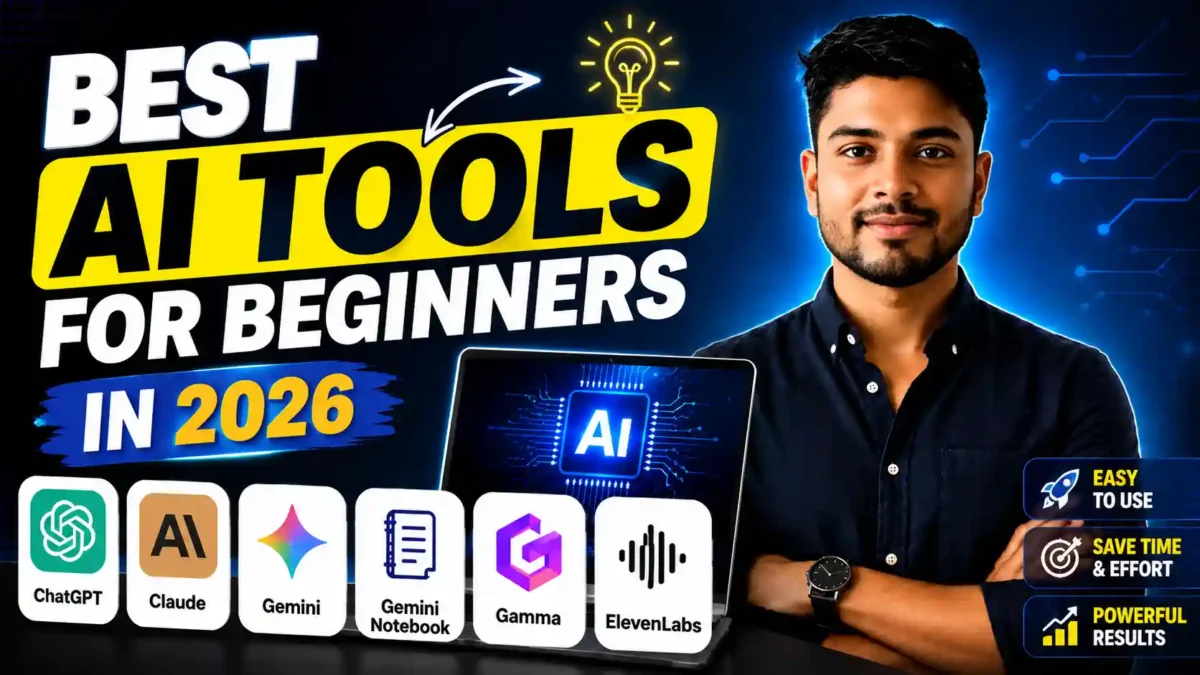

If you want the best AI tools for beginners in 2026 without wasting a month testing apps that don’t fit your workflow, the short version is this: start with one general chatbot, learn to write a real prompt, then add specialized tools only once you know what you actually need. Most people skip straight to installing five apps and end up using none of them well, which is usually why “best AI tools for beginners” searches turn up so many overwhelming, 25-item listicles instead of a clear starting point.
What Are the Best AI Tools for Beginners in 2026?
The best AI tools for beginners in 2026 are ChatGPT, Claude, and Google Gemini for general use, plus Gemini Notebook (formerly NotebookLM) for research, Gamma for presentations, and ElevenLabs for voice work. Together they cover almost every task a beginner runs into, from writing an email to summarizing a long PDF, without requiring any coding knowledge.
That list looks a little different than it did even a year ago. Google renamed NotebookLM to Gemini Notebook on July 16, 2026, folding it deeper into the Gemini product family, and according to Google’s own announcement, existing notebooks and sources carried over automatically. Pricing across the big three assistants has also settled into a tight cluster around $20 a month, so a lot of older “best AI tools for beginners” roundups online are already out of date on cost alone.
How to Choose the Best AI Tools for Beginners, Step by Step
You don’t need to understand machine learning to use these tools well. You do need a rough mental model of what each term means, because that’s what stops you from writing weak prompts and getting frustrated. Here’s the order that actually works when you’re building a shortlist of the best AI tools for beginners.
READ MORE
1. Understand What AI and Generative AI Actually Mean
Artificial intelligence, in plain terms, is software trained to recognize patterns in huge amounts of data and use them to make decisions or predictions. Generative AI is the specific branch that creates new content, rather than just analyzing what already exists. When ChatGPT writes you a paragraph or Gemini generates an image, that’s generative AI at work, producing something that didn’t exist before your prompt.
This distinction matters because it explains why these tools sometimes get things wrong. They’re not looking things up in a database. They’re generating a plausible answer based on patterns, which is powerful but not the same thing as verified fact-checking, and it’s the first thing any list of the best AI tools for beginners should explain before naming a single app.
2. Learn What a Prompt Is, and Why It Decides Everything
A prompt is simply the instruction you type or speak into an AI tool. It sounds obvious, but the quality of your prompt is the single biggest factor in the quality of your result. A vague prompt like “write me an email” forces the tool to guess at context it doesn’t have, and you’ll get a generic answer no matter which of the best AI tools for beginners you happen to be using.
Compare that to something specific: “write a formal email to my manager requesting tomorrow off, mentioning I’ll finish my current project by Thursday.” Same tool, dramatically better output. This single habit, being specific, is worth more than any tool you’ll pick.
3. Get Familiar With LLMs Before You Pick a Chatbot
LLM stands for large language model, the technology underneath ChatGPT, Claude, and Gemini. These models are trained on enormous volumes of text so they can predict, with impressive accuracy, what word should come next in a sentence. That’s the mechanism that lets them translate, summarize, and hold a conversation that feels natural.
As of April 2026, the flagship models behind these three assistants are GPT-5.5, Claude Opus 4.7, and Gemini 3.1 Pro, and all three now support roughly a million tokens of context, according to comparison data published by AI industry trackers. In practice that means you can paste in a genuinely long document and the model won’t lose track of the earlier parts, which is one reason all three still belong on any shortlist of the best AI tools for beginners.
4. Understand AI Agents (and Why They’re Different From Chatbots)
An AI agent goes a step beyond answering a single question. It’s built to pursue a goal across multiple steps, deciding on its own which tools to use along the way, similar to a personal assistant rather than a search box. Ask an agent to plan a trip and, in theory, it can check flights, compare hotel prices, and complete a booking with your approval, all without you walking it through each step.
This is still an emerging category in 2026, and most beginners don’t need one yet. But it’s worth knowing the term, since a growing share of new product launches this year are being marketed as agents rather than simple assistants, and that framing will only get louder in future best AI tools for beginners guides.
5. Match the Tool to the Job, Not the Hype
Different platforms genuinely specialize in different tasks, the same way different phone brands aren’t interchangeable even though they all make calls. Claude tends to lead for long documents, technical writing, and coding. ChatGPT remains the broadest all-rounder with the biggest lineup of plugins and third-party integrations. Gemini has the edge for anyone already living inside Gmail, Docs, and Google Search.
None of that means you need all three. Pick the one that matches your most frequent task, and only add a second tool once you hit a real limitation, not because a video told you it’s one of the best AI tools for beginners this month.
6. Test the Free Tiers Before You Pay for Anything
Every major assistant offers a workable free tier, and you should use it before subscribing to anything. According to OpenAI’s own free tier documentation, free ChatGPT users get unlimited everyday text chats along with web search, file uploads, and image generation, though tools like image generation and data analysis carry separate, smaller usage limits.
Here’s the honest friction point competitors rarely mention: those free-tier limits can feel inconsistent in practice. Threads on OpenAI’s own community forum describe users hitting a message cap mid-conversation with little warning, then being unable to continue until the limit resets hours later. It’s not a dealbreaker, but budget for that kind of interruption if you’re doing serious free-tier work, and it’s a fair reason some beginners eventually upgrade.
7. Write a Prompt Like a Professional, Not a Beginner
Once you’re comfortable with the basics, upgrade your prompts by giving the AI a role, a format, and a full list of requirements. Instead of “plan a trip to Kuakata,” try: “act as an experienced travel consultant, plan a five-day Kuakata trip for two people with a $250 budget, and present it as a table with daily costs.” The difference in output quality is not subtle.
This is the skill called prompt engineering, and it applies across every tool on this list. If you’ve ever felt an AI tool gives you flat, generic answers, the fix is almost always a better prompt rather than a different app, and it’s the one skill that separates casual users from people who get real value from the best AI tools for beginners category.
8. Add Specialized Tools Once You’ve Mastered the Basics
Once a general chatbot feels comfortable, layer in tools built for specific jobs. Gamma turns a short prompt into a full slide deck you can export straight to PowerPoint. Gemini Notebook, Google’s renamed version of NotebookLM, answers questions strictly from documents, websites, or videos you upload, rather than pulling from the open web, which makes it useful for studying or research where you want traceable sources.
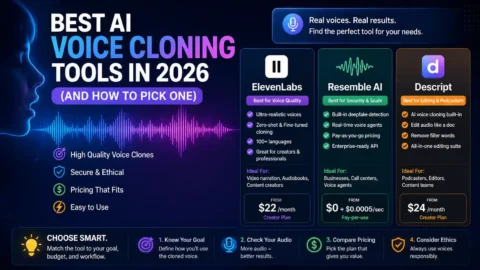
If your work leans toward video and voice content, it’s worth reading a fuller breakdown of the best free AI tools for content creators before you commit to a paid plan, and if voice is specifically your focus, a separate guide to the best AI voice cloning tools covers ElevenLabs and its main alternatives in more depth than this guide can.
Is ChatGPT Still One of the Best AI Tools for Beginners?
Yes, ChatGPT is still one of the best AI tools for beginners in 2026, mainly because of its free tier, its huge library of plugins, and its familiarity, though Claude and Gemini now match or beat it on specific tasks like long-document writing and Google Workspace integration. The right pick genuinely depends on what you’ll use it for most.
The table below lays out where each of the three big assistants stands as of mid-2026, based on published pricing and model comparison data, so you can judge for yourself which belongs on your personal list of the best AI tools for beginners.
| Assistant | Flagship model (2026) | Entry price | Best for |
|---|---|---|---|
| ChatGPT | GPT-5.5 | $20/month (Plus) | General use, widest plugin lineup |
| Claude | Claude Opus 4.7 | $20/month (Pro) | Long documents, technical writing, coding |
| Gemini | Gemini 3.1 Pro | $19.99/month (Google AI Pro) | Google Workspace and Search integration |
I’d push back a little on the idea that one of these three clearly “wins” as the single best AI tool for beginners. In my view, the pricing gap between them is close enough (within a dollar at the entry tier) that it’s not a meaningful factor for most people. What actually decides it is which platform you’re already using day to day, and whether you write long documents or short ones.
Common Mistakes Beginners Make With the Best AI Tools
Most beginner frustration with even the best AI tools for beginners traces back to a handful of repeat mistakes, not the tools themselves.
READ MORE
- Writing vague, one-line prompts and expecting a detailed, personalized result.
- Subscribing to a paid plan before testing whether the free tier actually falls short for your use case.
- Treating every answer as verified fact, instead of double-checking anything with real consequences.
- Ignoring personalization settings that let the tool remember your role, tone, and goals.
- Switching tools constantly instead of learning one well enough to write good prompts in it.
That last one deserves a second look. A beginner who spends two focused weeks with a single assistant, learning its quirks and building a habit of specific prompts, will usually get more value than someone who bounces between five different apps chasing whatever list claims to hold the best AI tools for beginners this week. If you eventually want to turn that skill into income, there’s a practical walkthrough on how to make money with ChatGPT worth reading once you’re past the basics.
Frequently Asked Questions About the Best AI Tools for Beginners
What is the single best AI tool to start with as a complete beginner?
For most beginners, ChatGPT is the easiest starting point because of its free tier and broad task coverage, though Claude is worth trying first if your main need is long-form writing or document analysis.
Do I need to pay for AI tools to get real value?
No. The free tiers of ChatGPT, Claude, and Gemini are genuinely functional, not stripped-down demos, and cover most everyday tasks; paid plans mainly add higher usage limits and access to the most advanced models.
What happened to NotebookLM?
Google renamed NotebookLM to Gemini Notebook on July 16, 2026. It’s the same standalone research tool at the same web address, with your existing notebooks and sources carried over automatically.
Is ChatGPT or Claude better for beginners who write a lot?
Claude tends to edge out ChatGPT for long-form writing and dense document analysis, while ChatGPT remains broader for everyday tasks and has the larger library of integrations and custom tools.
How long does it actually take to get comfortable with an AI tool?
Most people reach a comfortable working pace within one to two weeks of regular use, mainly by practicing specific, detailed prompts rather than by exploring every feature at once.
Final Thoughts
The best AI tools for beginners in 2026 aren’t necessarily the newest or most talked-about ones. They’re the ones that match what you’ll actually use week to week, paired with the habit of writing clear, detailed prompts. Start with one general assistant, get comfortable with prompt basics, and only branch out once you hit a real limitation rather than a hunch that another app on some other best AI tools for beginners list might be better.

You Might Also Like

The Only Free AI Tool Everyone Should Use, and it is Open Source: An Overview
How to Build a Chrome Extension With AI in 7 Easy Steps
Gemini 3.8 Flash: The Important Upgrade Is Not Just Speed

AI Existential Risk: Anthropic’s 10% Warning Explained
Automatic Caption Generator: 5 Costly Mistakes to Avoid
Leave a Reply