
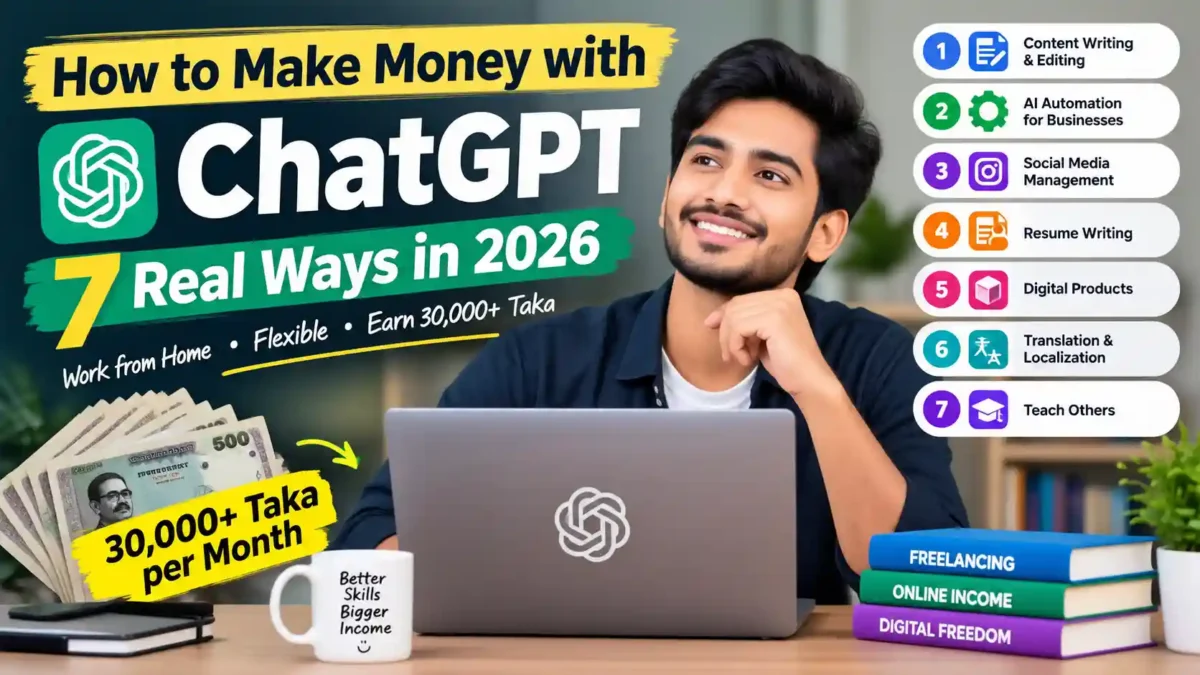

Picture two people who signed up for ChatGPT on the same day. One uses it to draft a grocery list and the occasional email. The other used it to land a $500 freelance gig by the end of the week.
If you’re wondering how to make money with ChatGPT and you feel closer to the first person, the difference usually isn’t skill. It’s that the second person picked one specific, sellable task and stuck with it.
Here’s the direct answer: you make money with ChatGPT by using it to do paid work faster, not by selling ChatGPT access itself. The seven paths below all follow the same pattern. ChatGPT handles the first draft, and you handle the judgment, the editing, and the client relationship.
Why Making Money With ChatGPT Got Harder, Then Easier Again
It’s worth being honest about this shift instead of only selling the upside. Upwork’s writing category saw job postings drop by roughly 32% year over year as more clients started drafting simple briefs themselves, and Brookings Institution research found freelancers in AI-exposed roles saw about a 5% dip in monthly earnings following major model releases. That’s real friction, not a hypothetical.
But the same shift created new demand for people who adapted. A Fiverr survey of 3,500 freelancers found 76% now use AI tools regularly, with 64% reporting real productivity gains and an average of 8.1 hours saved per week. Freelancers Union data from early 2026 found that people who openly market AI-augmented services charge 23% to 40% more than those who don’t mention AI at all. The work moved. It didn’t vanish.
What this means for a beginner is simple: you are not competing against ChatGPT. You are competing against other freelancers who may or may not know how to use it well. The advantage goes to the person who can combine fast AI drafting with human judgment, client communication, and a reliable delivery process.
7 Ways to Make Money With ChatGPT
Before you pick one, look at the table below. It shows the realistic skill level, startup cost, and time to first income for each method. Most beginners do better by choosing the path that matches a skill they already have rather than chasing the highest possible income.
| Method | Skill needed | Startup cost | Time to first income | Realistic monthly range |
|---|---|---|---|---|
| Freelance content writing | Writing, basic research | $0 | 1–2 weeks | $300–$3,000 |
| AI automation for local businesses | Basic no-code tools | $0–$50 | 2–4 weeks | $500–$5,000+ |
| Social media management | Content sense, consistency | $0 | 2–3 weeks | $400–$2,500 |
| Resume and cover letter writing | Writing, empathy | $0 | 3–7 days | $200–$1,500 |
| Digital products | Subject knowledge, basic design | $0–$100 | 2–6 weeks | $100–$3,000+ |
| Translation and localization | Fluency in two languages | $0 | 1–3 weeks | $300–$2,000 |
| Teaching others | Confidence, communication | $0–$20 | 1–4 weeks | $200–$5,000+ |
1. Freelance Content Writing and Editing
Small businesses, blogs, and local service companies constantly need content and rarely have someone in-house to write it. Use ChatGPT for the first draft, then rewrite it in your own voice, verify every fact, and add specifics the model couldn’t have known.
This step matters: one widely shared account from a freelance writer described losing a client after an AI detector flagged a submission as over 90% AI-generated, so unedited output is a real risk to repeat business.
Build two or three strong samples before you pitch anyone, and list your service with a specific niche (SaaS blogs, product descriptions for online stores) rather than a generic “AI writer” title. Specialists consistently out-earn generalists in this category.
Real-world example: A beginner writer picks “email newsletters for independent coffee shops.” She writes three sample newsletters, one for a fictional shop, one for a local café she frequents, and one rewritten from a bad AI draft. She charges $150 per newsletter, finds five cafés on Instagram, and sends each a personalized pitch. Two say yes. That is $300 in her first week.
Where to find clients: Facebook groups for small business owners, local chambers of commerce, LinkedIn, and niche Slack or Discord communities. Avoid general freelance marketplaces when you are starting because you will compete on price with hundreds of other listings.
Pricing tip: Charge per project, not per hour. A 1,000-word blog post that takes you two hours is not a $20 job. It is a $100–$300 deliverable because the client gets a finished asset that supports their business.
2. Build Paid AI Automation for Local Businesses
A chatbot answers a question. An agent actually processes a return, updates a spreadsheet, or sends a follow-up email on its own, and that’s the version businesses will pay for. No-code platforms like n8n, Zapier, or Make connect ChatGPT to tools a business already uses, so you don’t need to write custom code to get started.
Our full guide on how to earn money from an AI agent covers the setup process in detail, including the $500 to $1,500 setup fee plus $100 to $300 monthly retainer most beginners charge.
Real-world example: A local dentist’s office misses calls after hours. You set up a simple automation that sends a text-back to missed callers, collects their name and preferred appointment time, and adds it to a Google Sheet. The dentist pays $800 to set it up and $150 a month to maintain it. You built it once in an afternoon using Zapier and ChatGPT.
Where to find clients: Local businesses with visible online reviews but no online booking system, gyms, salons, clinics, real estate agents, and restaurants. Walk in, call, or send a short Loom video showing exactly what you would automate.
Pricing tip: Charge a setup fee plus a monthly retainer. The setup fee covers your build time. The retainer covers monitoring, small edits, and the peace of mind that the automation will not break silently.
3. Social Media Management for Small Businesses
Shop owners want an active Instagram or Facebook page but almost never have time to post daily. Draft captions, a monthly content calendar, and hashtag sets with ChatGPT, then sell it as a recurring monthly service instead of a one-off task. This is the same kind of AI-augmented offer behind that 23% to 40% rate premium mentioned earlier, since clients are paying for consistency they can’t maintain on their own.
Real-world example: A bakery owner posts once a week when she remembers. You offer a $400/month package: 12 posts, 4 stories, and a simple monthly report. You use ChatGPT to draft captions from her photos and a content calendar, then schedule everything in Buffer or Meta Business Suite. She gets consistency. You get recurring income.
Where to find clients: Instagram and Facebook are your portfolio. Before pitching, rewrite three posts for a local business and send them as a free sample. That single gesture converts better than a generic message.
Pricing tip: Sell packages, not individual posts. A “starter” package with 12 posts, a “growth” package with 20 posts plus stories, and a “full” package with Reels scripts and engagement. Recurring revenue is the goal.
4. Resume and Cover Letter Writing
Job seekers are a constant market, and most people freeze up describing their own achievements on paper. ChatGPT can turn a messy work history into a structured draft quickly. The value you’re actually selling is judgment: which accomplishments to lead with, what to cut, and how to match a specific job posting.
Price this like other short-form writing services and find clients in job-seeker Facebook groups rather than crowded general freelance marketplaces, where you’ll compete on price against hundreds of similar listings.
Real-world example: A client has ten years of retail experience but a two-page resume that says nothing. You interview them for 20 minutes, feed the notes into ChatGPT, and produce a one-page resume tailored to a store manager role. You charge $120. It takes you 90 minutes. If you do three a day, that is $360 daily.
Where to find clients: Facebook groups like “Job Seekers [Your City],” LinkedIn, university career groups, and Reddit communities such as r/resumes. Post a before-and-after sample with personal details removed.
Pricing tip: Offer a free 10-minute consultation. It builds trust and lets you quote accurately. Charge more for rush delivery or LinkedIn profile optimization as an add-on.
5. Create and Sell Digital Products
E-books, templates, and checklists can be drafted with ChatGPT and sold repeatedly through Gumroad or Amazon Kindle Direct Publishing, both of which handle delivery and payment automatically. You build the asset once and it keeps selling.
Our roundup of free AI tools for content creators covers the design tools that pair well with ChatGPT here, since a plain text product tends to sell worse than one with real formatting and visuals.
Real-world example: A teacher creates a “Classroom Management Checklist” for new teachers. ChatGPT helps outline it. Canva makes it look professional. She sells it on Gumroad for $9. She shares it in three teacher Facebook groups. It sells 40 copies in the first month, earning $360 with zero delivery cost.
Where to find buyers: Niche communities where your product solves a specific problem. Teachers, nurses, real estate agents, freelancers, and hobby groups all have active online forums.
Pricing tip: Start with a low-priced product ($5–$15) to build reviews and trust, then create a bundle or a higher-priced course later.
6. Translation and Localization Services
Demand for translating business content into other languages keeps growing as companies expand into new markets. ChatGPT can produce a fast first-pass translation, but the paid service is your review pass: catching idioms that don’t translate literally and confirming technical terms are accurate.
This only works as a real service if you’re genuinely fluent in both languages, since an unreviewed AI translation is a fast way to hand a client an embarrassing mistake.
Real-world example: A company wants its app translated from English to Spanish. ChatGPT produces a draft in minutes. You spend two hours reviewing it, fixing tone, and localizing phrases for Mexican Spanish rather than Castilian. You charge $0.08 per word, and the project is 5,000 words, so you earn $400.
Where to find clients: Translation agencies, Upwork, ProZ, and direct outreach to SaaS companies that have an English-only website but serve international customers.
Pricing tip: Charge per word, not per hour. Standard rates range from $0.06 to $0.15 per word depending on the language pair and specialization. Technical and legal translations command more.
7. Teach Other People How to Use ChatGPT
By the time you’ve tried a few of the methods above, you already know more than most small business owners and job seekers around you. Package that into a short paid workshop or one-on-one coaching session.
At the more built-out end of this path, creators are publishing custom GPTs in OpenAI’s GPT Store priced between $5 and $30 a month per user, and a small number of top creators reportedly earn six figures a year through engagement payouts and bundled subscriptions.
Real-world example: A freelancer runs a free 30-minute “ChatGPT for Beginners” session at a local co-working space. Ten people attend. Four sign up for a $99 two-hour one-on-one session. That is $396 from a single afternoon.
Where to find students: Local libraries, co-working spaces, community centers, LinkedIn, and Facebook groups for entrepreneurs. Record a short demo and share it.
Pricing tip: Start with a free or low-cost workshop to build credibility. Then offer a paid deeper session or a monthly group coaching subscription.
How Much Can You Realistically Make With ChatGPT?
There’s no fixed number, and anyone promising a guaranteed monthly income is selling something. Realistic early income across most ways to make money with ChatGPT lands in the few hundred to a few thousand dollars a month range within the first three to six months, growing as you land repeat clients.
In my view, the people who reach the higher end of that range aren’t the ones with the cleverest prompts. They’re the ones who picked one narrow service, priced it around the time it saved the client rather than what it cost them to produce, and kept showing up for the same clients month after month instead of chasing new ones constantly.
What ChatGPT Plan Do You Need to Make Money With ChatGPT?
Most of the seven methods above work fine on ChatGPT’s free tier while you’re testing an idea. Plus, priced at $20 a month and unchanged for three years, removes the usage caps that start costing you time once you’re doing this daily for paying clients.
| Plan | Monthly Price | Best For |
|---|---|---|
| Free | $0 | Testing an idea, occasional use |
| Go | $8 | Light daily chat use, still ad-supported |
| Plus | $20 | Daily freelance or client work |
| Pro (100) | $100 | Heavy daily use, coding, deep research |
It’s also worth knowing that Anthropic’s Claude has actually pulled ahead of ChatGPT on enterprise revenue since mid-2025, even though ChatGPT still holds the much larger consumer user base. If a client-facing automation project is your main goal rather than personal freelance writing, it’s worth testing both tools before committing to one subscription.
How to Price Your ChatGPT-Powered Services
Most beginners undercharge because they calculate what the work costs them instead of what it is worth to the client. A blog post that takes you one hour is not a $20 job if it helps a client rank on Google and attract customers. Price the outcome, not your typing speed.
- Per project: Best for writing, resumes, and digital products. Quote a flat fee based on scope.
- Monthly retainer: Best for social media, automation maintenance, and ongoing content. Predictable income for you, predictable results for the client.
- Setup fee plus retainer: Best for automation. The setup fee covers the build; the retainer covers support.
- Per word: Best for translation and high-volume content. Common for agency work.
- Value-based: Best for high-impact projects. If your automation saves a business 10 hours a week, a $1,000 setup fee is easy to justify.
A Simple 30-Day Plan to Your First $500
If you want a structured way to start instead of reading endlessly, follow this plan.
Week 1: Pick One Method and Build a Sample
- Choose one method from the seven above that matches a skill you already have.
- Create two or three strong samples. For writing, write for a fictional business. For automation, record a short screen demo. For resumes, create a before-and-after mockup.
- Set a price. Do not guess. Use the pricing guidance above.
Week 2: Find 20 Potential Clients
- Make a list of 20 businesses or individuals who fit your offer.
- Find their contact email or social profile.
- Write a short, personalized message. Mention something specific about their business.
- Do not send a generic “I do AI writing” message. Offer one clear result.
Week 3: Follow Up and Close One Client
- Follow up with everyone who did not reply after three days.
- Offer a small paid test project if they are hesitant.
- Deliver the first project faster than promised and over-deliver slightly.
- Ask for a testimonial and a referral immediately after delivery.
Week 4: Systemize and Raise Your Price
- Document your process so you can repeat it faster.
- Ask the client if they need ongoing work. Convert one-off projects into retainers.
- Raise your price for the next client by 20%.
- Repeat the outreach process with 20 new prospects.
Mistakes That Slow Down ChatGPT Income
Most people who struggle to make money with ChatGPT don’t fail because the tool couldn’t do the work. They fail on the business side of things.
- Sending ChatGPT output straight to a client without editing or fact-checking it first. Fix: treat every AI draft as a first pass. Rewrite, verify, and add specifics.
- Writing prompts so vague that the output comes back generic, then blaming the tool. Fix: use the Role + Task + Context + Format + Constraints formula.
- Pricing based only on how little the work costs you, instead of the value it delivers. Fix: research what others charge and price the outcome.
- Trying to serve every niche at once instead of one specific, sellable service. Fix: pick one niche and become the obvious choice for it.
- Giving up after five rejected pitches. Fix: expect 20 to 30 outreach messages for every one client. That is normal.
That second mistake trips up more people than it should. If your prompts keep coming back vague or off-target, our breakdown of why ChatGPT prompts fail covers the specific fixes, and the cause is usually a missing detail rather than a broken tool.
Legal, Tax, and Ethical Points Beginners Should Know
If income from any of these methods becomes a meaningful part of your finances, a conversation with a tax professional about self-employment income and quarterly estimated taxes is a reasonable step to take early, not something to figure out after the fact.
- Disclose AI use when asked. Most clients do not mind AI assistance. They mind being misled.
- Fact-check everything. ChatGPT can invent statistics, quotes, and sources. Verify before delivery.
- Do not copy copyrighted material. Use ChatGPT to draft original work, not to reproduce someone else’s content.
- Keep records. Track income and expenses from day one. It makes tax time far easier.
- Protect client data. Do not paste confidential information into a tool if the client has not approved it.
Frequently Asked Questions
Do I need ChatGPT Plus to start making money with it?
No. The free tier is enough to test any of these seven methods and land a first client. Upgrade to Plus once usage limits are genuinely slowing down paid work.
Is it OK to sell content that ChatGPT helped write?
Yes, as long as you disclose AI use when a client or platform asks and you personally review, fact-check, and edit the output before delivering it. Passing off unedited AI text as fully hand-written work is what damages trust, not the assistance itself.
What’s the fastest way to make money with ChatGPT this week?
Freelance writing or resume writing tend to have the shortest path to a first paid gig, since job-seeker and small-business Facebook groups are full of people who need the work done now and don’t expect a portfolio.
Will clients be able to tell I used ChatGPT?
Sometimes, especially if the output isn’t edited. AI detection tools are common enough now that treating every ChatGPT draft as a first pass rather than a final deliverable protects both the work and the client relationship.
How many clients do I need to replace a full-time income?
It depends on your pricing. If you charge $500 per project, you need four clients a month to earn $2,000. If you charge $300 per month in retainers, you need seven clients to earn $2,100. Recurring clients are more stable than one-off projects.
Can I make money with ChatGPT without showing my face?
Yes. Freelance writing, resume writing, digital products, translation, and automation setup can all be done without appearing on camera. Teaching and social media management may require more visibility, but even those can be done with a logo or brand account.
Learning how to make money with ChatGPT really comes down to picking one of these seven paths and treating the AI output as a fast first draft rather than the finished product. Start with whichever method matches a skill you already have, then let ChatGPT make you faster at it instead of expecting it to replace the work entirely.

You Might Also Like

How to Make a Living Statue Prank Video with AI (Step-by-Step Guide)

New AI Tools 2026 That Are Changing How We Work
Meta Muse AI Agent Review 2026: My Honest 2-Week Test Results
9 Open-Source Business Tools to Save Money and Grow

Crreo AI Free Plan Explained: Limits, Pricing Sources and How to Test It
Leave a Reply