
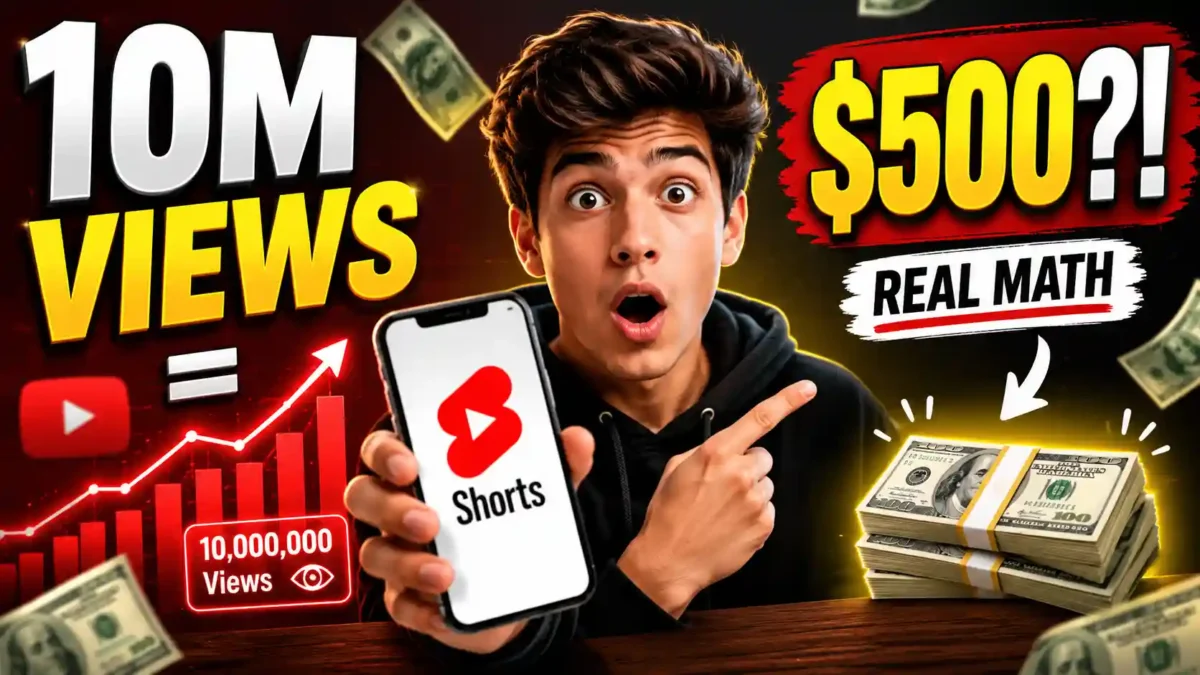

So you’ve seen the screenshots. Some creator posts a Short that hits 4 million views overnight and people assume that’s a payday. It’s a fair question to ask if you can actually make money from YouTube Shorts, and the honest answer is yes, but the math is a lot less exciting than the view counts make it look. Shorts revenue works on a shared pool, not a per-video ad rate, and once you see how that pool gets divided up, the numbers start making a lot more sense.
This isn’t a hype piece and it isn’t a “give up now” piece either. It’s the actual arithmetic, the real requirements, and a straight answer about what kind of view volume turns into real dollars. It also covers the mistakes that cost creators money, a 30-day plan to get started, and why most successful Shorts creators treat the format as a discovery engine first and a revenue stream second.
The Short Answer: Yes, But the Rate Per View Is Tiny
YouTube Shorts can generate real income, but the revenue per 1,000 views (RPM) is far below long-form video. Most Shorts creators in the United States are looking at something like $0.03 to $0.08 per 1,000 views from ad revenue alone, according to breakdowns from vidIQ and Mediacube’s 2026 creator data. Compare that to long-form YouTube, where RPM often lands between $3 and $12 per 1,000 views depending on the niche, and you can see the gap immediately.
Shorts pay less because the ad inventory is thinner and the format was built for volume, not for parking a viewer in front of a 30-second pre-roll ad. That doesn’t mean Shorts are worthless. It means the money mostly comes from scale, not from any single video doing well.
Real-world example: A creator posts a Short that gets 1 million views. At a $0.05 RPM, that’s $50. The same creator posts a long-form video that gets 100,000 views. At a $5 RPM, that’s $500. The long-form video earned ten times more with one-tenth the views. This is why many creators use Shorts to drive traffic to long-form content, where the real ad revenue lives.
How the Shorts Revenue Pool Actually Works
Unlike a regular long-form video, where an ad plays on your specific video and you get a cut of that specific ad, Shorts revenue doesn’t work per video. Every ad shown between Shorts in the main feed goes into one big regional pool. At the end of the month, YouTube looks at how many monetized Shorts views you got compared to everyone else’s monetized Shorts views in your region, and pays you a proportional slice.
READ MORE
There’s also a music licensing wrinkle most creators don’t know about. If your Short uses a licensed track, a chunk of the pool goes to cover that licensing cost before creators get paid. Shopify’s breakdown of the system lays this out clearly: Shorts using no music send 100 percent of their share of ad revenue into the creator pool, Shorts using one track send around half, and Shorts using two tracks send closer to a third. So two creators with identical view counts can end up with noticeably different payouts depending on whether they used a trending audio clip or their own voiceover.
Once the creator pool is calculated, YouTube keeps 55 percent and pays out the remaining 45 percent to eligible creators based on their share of views that month.
Real-world example: Creator A uses original audio in a Short that gets 2 million views. Creator B uses a popular licensed song in a Short that also gets 2 million views. Because Creator B’s Short uses licensed music, a portion of the revenue that would have gone to the creator pool is diverted to cover licensing. Creator B’s payout could be 30–50% lower than Creator A’s, even though the view counts are identical.
Step-by-Step: Figuring Out What Your Shorts Would Actually Earn
Step 1: Check If You Even Qualify for Shorts Monetization
Before any math matters, you need to be in the YouTube Partner Program. For Shorts specifically, that means 1,000 subscribers plus 10 million valid Shorts views in the trailing 90 days, based on vidIQ’s 2026 monetization guide. There’s a separate long-form path (1,000 subscribers and 4,000 watch hours in 12 months) but that one doesn’t apply if Shorts is your main format.
It’s also worth checking that your country is on YouTube’s supported list for the Partner Program, since eligibility by region isn’t universal, and YouTube Studio simply won’t let you opt in if your country isn’t included yet.
Step 2: Estimate Your Realistic RPM
Your RPM depends heavily on where your viewers live. US, Canadian, and Australian audiences sit at the higher end of the Shorts range, roughly $0.03 to $0.08 per 1,000 views. Audiences in India or Southeast Asia often see rates closer to $0.003 to $0.015 per 1,000 views, according to figures compiled by Conbersa. If your audience is spread across regions, your blended RPM will land somewhere in between, weighted toward wherever most of your views come from.
Step 3: Multiply It Out at Your Actual View Count
Here’s where the math gets grounding. At a $0.05 RPM, which is roughly the middle of the common range, 1 million views earns about $50. Ten million views, which is also the threshold you need just to unlock monetization in the first place, earns somewhere around $500. A genuinely viral run of 100 million views across a month would land closer to $5,000, which sounds better, but 100 million views is a huge amount of reach to sustain month after month.
This is the part of the “make money from YouTube Shorts” conversation that most creators skip past, because the view counts feel big long before the payout catches up.
Step 4: Stack Shorts With Other Income Sources Instead of Relying on Ads Alone
Almost every current guide on this topic lands on the same conclusion: ad revenue from Shorts alone rarely pays real bills, but Shorts are excellent at generating the audience that other income sources depend on. Once you’re eligible for monetization, a few paths tend to matter more than the ad pool itself.
- Brand deals and sponsorships, which pay based on reach and engagement rather than YouTube’s ad pool.
- Affiliate links placed in Shorts descriptions or pinned comments.
- Channel memberships and Super Thanks from viewers who stick around.
- Digital products, merch, or a paid newsletter promoted through Shorts.
- Using Shorts as a funnel into long-form videos, where RPM can run 50 times higher.
That last point comes up constantly in creator economy research, and it’s probably the single most useful thing to understand: Shorts are a discovery engine first and a revenue stream second.
Step 5: Decide If the Effort-to-Payout Ratio Makes Sense for You
If your goal is a full income from Shorts ad revenue alone, the numbers above should be a reality check. If your goal is building an audience efficiently, using Shorts to funnel people toward long-form content, memberships, or a product, the math works a lot better. It’s less about whether Shorts pay and more about what you’re using them to build toward.
What stood out while researching this topic is how consistent the numbers are across independent sources. TubeBuddy, vidIQ, and Conbersa all land in roughly the same $0.03 to $0.08 range for US RPM, which suggests these aren’t cherry-picked figures from one platform trying to sell a course. When multiple outside trackers land on the same range independently, that’s usually a sign the number reflects reality rather than an outlier or a marketing angle.
Is Shorts RPM Getting Better Over Time?
Slowly, yes. YouTube expanded ad load in the Shorts feed through 2025 and into 2026, which has grown the overall pool available to creators, and some estimates put the increase at roughly 15 to 25 percent over 2024 levels. YouTube has also rolled out Shorts Bonuses for fast-growing channels as an extra layer on top of standard pool payouts. None of this puts Shorts anywhere near long-form RPM, and there’s no indication that’s the direction things are headed, but the trend line is upward rather than flat.
READ MORE
What Actually Moves Your Shorts RPM Up or Down
A few factors do meaningfully change your rate, even within the normal range.
- Viewer location is the biggest lever, since ad rates in the US, UK, Canada, and Australia are simply higher than in most other regions.
- Music choice matters too. Using original audio or a voiceover instead of a licensed trending sound means less of your share gets diverted to cover licensing costs.
- Niche plays a role as well; finance, tech, and business content tend to attract higher-paying advertisers even in the Shorts feed, similar to how those niches out-earn others in long-form.
- Engagement quality (average view duration, not just raw views) affects your standing in the pool, since YouTube weighs higher-quality watch sessions more heavily than a quick two-second glance.
Even at a $0.05 RPM, a Short reaching 10 million views generates roughly $500. The volume is doing the work, not the rate.
Common Mistakes That Cost Shorts Creators Money
Using licensed music without realizing the cost. Every licensed track in a Short diverts a portion of your revenue to cover licensing. If you’re aiming to maximize ad revenue, use original audio or royalty-free music instead.
READ MORE
Chasing views without a plan for what happens next. A viral Short that sends viewers nowhere is a missed opportunity. Always include a call to action that points to your long-form content, a product, or a newsletter.
Ignoring audience location. If most of your views come from regions with low ad rates, your RPM will stay low no matter how many views you get. Consider creating content that appeals to higher-RPM regions if ad revenue is a priority.
Deleting underperforming Shorts. Removing content rarely raises your channel’s RPM, and it can hurt performance signals YouTube uses to recommend your videos going forward. Leave old Shorts up; they can still accumulate views over time.
Giving up before hitting the monetization threshold. Ten million Shorts views in 90 days is a high bar. Many creators quit just before they qualify. Consistent posting and a focus on watch time can get you there.
A 30-Day Plan to Start Earning From YouTube Shorts
Week 1: Understand the Rules and Set Your Baseline
- Check your eligibility for the YouTube Partner Program and confirm your country is supported.
- Review your existing Shorts: how many views did they get in the last 90 days?
- Identify your top-performing Shorts and note what they had in common (topic, length, music, hook).
Week 2: Optimize for Watch Time and Engagement
- Focus on the first three seconds of every Short. Make the hook impossible to scroll past.
- Avoid licensed music if you’re aiming for ad revenue. Use original audio or royalty-free tracks.
- Add captions to every Short. Most viewers watch with sound off.
- Post at least one Short per day to gather data on what works.
Week 3: Build a Funnel to Higher-Value Content
- Create a long-form video that expands on your most popular Short.
- Add a pinned comment on your Shorts linking to the long-form video.
- If you have a product, newsletter, or affiliate link, include it in your Shorts descriptions.
- Engage with comments to boost engagement signals.
Week 4: Review, Adjust, and Scale
- Calculate your views for the month and estimate your RPM based on your audience location.
- Double down on the Shorts format that got the most watch time, not just the most views.
- If you’re close to the 10 million view threshold, keep posting consistently.
- Consider collaborations or cross-promotion with other creators to accelerate reach.
Frequently Asked Questions
How many views do you need to make $100 from YouTube Shorts?
At a typical $0.05 RPM, you’d need roughly 2 million views to reach about $100 in ad revenue. That number moves up or down depending on your audience’s location and whether your Shorts use licensed music.
READ MORE
Do you need 1,000 subscribers to make money from YouTube Shorts?
Yes. Shorts ad revenue specifically requires 1,000 subscribers plus 10 million valid Shorts views in the last 90 days to join the Partner Program through the Shorts path.
Is YouTube Shorts money worth chasing compared to TikTok?
Instagram Reels bonuses and TikTok’s Creator Rewards Program tend to land in a comparable low range to Shorts, often between $0.01 and $0.03 per 1,000 views, so no single short-form platform is a clear ad revenue winner. Most creators who take this seriously post across all three and treat each as a discovery channel rather than picking one for the ad payout alone.
Can Shorts alone replace a full-time income?
For the large majority of creators, no, not from ad revenue by itself. It generally takes a very high, sustained view volume every month, plus additional income sources like sponsorships or products, for Shorts to add up to a full-time living.
Does deleting underperforming Shorts help your RPM?
Usually not. Removing content rarely raises your channel’s RPM, and it can hurt performance signals YouTube uses to recommend your videos going forward.
What is the highest RPM you can get from Shorts?
RPM varies by niche and audience. Finance, tech, and business content can push RPM toward the higher end of the $0.03 to $0.08 range, and if your audience is primarily in the US, UK, Canada, or Australia, you’ll see better rates than creators with mostly low-RPM regions.
How often does YouTube pay for Shorts?
YouTube pays monthly, usually around the 21st of the month, once you’ve met the $100 payment threshold in your AdSense account.
The Bottom Line
Actual earnings vary a lot by audience location, niche, and music choices, so treat every figure here as a general estimate rather than a guarantee, and run your own numbers before making decisions about your time or budget. Can you really make money from YouTube Shorts? Yes, but the honest math says it’s a volume game with a small per-view rate, not a shortcut to fast cash.
The creators who end up genuinely earning from the format are rarely relying on the ad pool by itself. They’re using Shorts to build an audience, then converting that audience into long-form viewers, sponsorship deals, or a product of their own. If you go in expecting that, the math actually starts to work in your favor.
Start with one Short this week. Study the hook, use original audio, add captions, and link to something valuable. Then do it again. The view counts will follow, and so will the income, just not in the way the screenshots suggest.



Leave a Reply